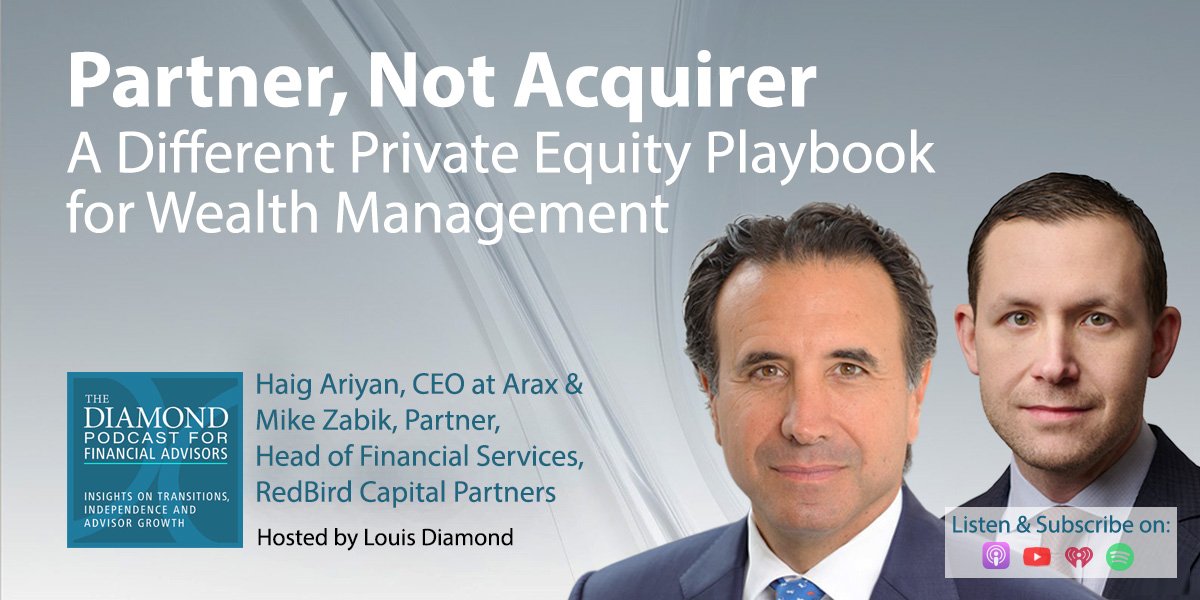
With Haig Ariyan — CEO at Arax and
Mike Zabik — Partner, Head of Financial Services at RedBird Capital Partners
How Arax and RedBird built a $50B wealth management firm around advisor ownership, organic growth, wirehouse recruiting, and a different approach to private equity.
In Summary
Private equity has become a powerful force in wealth management, but not every investor approaches the opportunity the same way. Haig Ariyan, CEO of Arax, and Mike Zabik, Partner at RedBird Capital Partners, share how they built a firm from scratch rather than acquiring an existing platform, growing it to approximately $50B in assets and 230 financial advisors.
In this conversation with Jason Diamond, they explore what it means to be a partner rather than an acquirer, why advisor equity ownership can accelerate organic growth, and how a hybrid platform can deliver wirehouse-level capabilities with greater flexibility. They also address the questions surrounding private equity valuations, leverage, and exit timelines, along with the opportunities they see in wirehouse team liftouts, ultra-high-net-worth wealth management, and AI-driven advisor productivity.
The Storyline
There’s no shortage of private equity firms looking to invest in wealth management. And with valuations reaching historically high levels, the competition to acquire established RIAs and recruit successful financial advisors has become increasingly intense.
Yet the partnership between Arax and RedBird Capital Partners began with a different premise.
Rather than acquire an established wealth management platform and find someone to run it, RedBird set out to find an experienced operator with whom it could build a business from the ground up.
That search led Mike Zabik to Haig Ariyan, a veteran wealth management executive whose experience included leadership roles at Alex. Brown and Raymond James.
Together, they envisioned a business that would combine the resources, infrastructure, and capital of a large financial institution with the flexibility, ownership opportunities, and entrepreneurial culture of an independent firm.
The result was Arax, which has grown to approximately $50B in assets and 230 financial advisors.
Their guiding philosophy is to become a “partner of choice, not an acquirer of choice.”
But what does that actually mean for financial advisors?
For Haig, it means building a platform where advisors help shape the capabilities they use, maintain control over how they serve clients, and participate meaningfully in the equity value of the enterprise they’re helping to grow.
For Mike, it means investing in the right people, prioritizing organic growth alongside acquisitions, and resisting the pressure to make business decisions around a predetermined private equity exit timetable.
Their discussion with Jason goes well beyond the Arax growth story.
They examine the economics of private equity-backed wealth management, including why Mike believes certain businesses can justify EBITDA multiples exceeding 20 times, how leverage complicates the outlook for the largest consolidators, and what advisors should understand about the eventual return of investor capital.
They also explore why relatively few PE-backed firms have successfully recruited wirehouse teams directly, despite the significant opportunity, and why Haig considers transition execution just as important as recruiting.
Looking ahead, both see opportunities in increasingly complex client needs, the growth of ultra-high-net-worth wealth management, and AI technology that expands advisor capacity.
It’s a conversation about the relationship between capital and entrepreneurship, and how the right partnership can influence the business an advisor builds, the clients they serve, and the value they ultimately create.
Topics Covered
- How Arax and RedBird built a wealth management platform from scratch
- The difference between private equity investors and true operating partners
- Why Arax emphasizes advisor equity ownership and entrepreneurial culture
- How hybrid RIA and broker dealer capabilities support sophisticated advisors
- What wirehouse advisors gain, and what changes, when joining an independent platform
- The relationship between organic growth, M&A, and enterprise value
- How advisor equity can create additional incentives for growth
- Why integrated capabilities, technology, and organic growth influence valuations
- Private equity EBITDA multiples, leverage, and the potential for RIA IPOs
- RedBird’s philosophy on exit timing and long-term capital partnerships
- Why direct wirehouse team liftouts remain an underdeveloped opportunity
- How AI can improve client onboarding, reporting, prospecting, and advisor productivity
- The growing opportunity in ultra-high-net-worth wealth management
Podcast: Play in new window | Download (Duration: 55:53 — 76.8MB) | Embed
Subscribe: Apple Podcasts | Spotify | Amazon Music | Pandora | iHeartRadio | Podchaser | TuneIn | Deezer | Anghami | RSS
Listen and Learn Highlights for Advisors
The origin of a different private equity partnership (04:07) — Mike explains why RedBird was looking for an experienced operator rather than an established platform, and how meeting Haig led to a shared vision for building Arax.
Why Arax was designed differently from traditional RIA aggregators (07:27) — Mike describes RedBird’s approach to building businesses from the ground up, while Haig explains the importance of developing a hybrid platform with broker dealer capabilities.
How advisor equity ownership changes the relationship (11:34) — Haig discusses creating meaningful ownership opportunities for financial advisors, including the distinction between equity participation and traditional employee forgivable loan arrangements.
What independent wealth management can offer wirehouse advisors (18:29) — Haig compares the prescribed capabilities of traditional firms with a partnership model where advisors help shape the resources, services, and solutions available to their clients.
Why organic growth matters more than acquisitions alone (20:59) — Mike explains the economics of organic versus inorganic growth, and why he believes firms with strong organic growth profiles command a premium.
How equity ownership can accelerate advisor growth (26:13) — Haig describes how ownership gives advisors another reason to grow their practices, expand existing client relationships, and participate in enterprise value creation.
What advisors should understand about private equity valuations (33:04) — Jason challenges Mike on high EBITDA multiples and the sustainability of PE-backed wealth management valuations. Mike addresses the economics of building a platform, market fragmentation, and the outlook for larger consolidators.
The truth about private equity exit timelines (37:37) — Mike explains why RedBird does not operate Arax around a predetermined exit date, while acknowledging its responsibility to eventually return capital to investors.
How AI and integration are shaping Arax’s next phase (41:21) — Haig discusses technology integration, advisor feedback, and how RedBird’s AI team is supporting reporting, practice management, and organic growth.
Why more PE-backed RIAs haven’t recruited directly from wirehouses (44:01) — Jason and Haig examine the challenges of direct team liftouts, including recruiting expertise, transition capabilities, and protecting the client experience.
Where the next wealth management growth opportunities may emerge (49:10) — Mike identifies generational wealth transfer, ultra-high-net-worth clients, team liftouts, and AI-enabled business development as significant opportunities.
AI as augmented intelligence, not advisor replacement (52:23) — Mike explains how RedBird is using AI to increase employee efficiency, improve client acquisition, and free advisors to spend more time on relationships.
Key Takeaways
1. The right operating partner can be more important than the acquisition opportunity.
RedBird’s decision to build around Haig rather than purchase an existing platform reflects its belief that leadership, operational experience, and entrepreneurial alignment are fundamental to creating enterprise value. For advisors evaluating PE-backed firms, understanding who is making decisions and how the investor and operator work together may be as important as the financial terms.
2. Advisor ownership can fundamentally change the growth equation.
A traditional recruiting package may compensate an advisor for changing firms. Meaningful equity participation offers a different opportunity: to share in the value of the larger enterprise. Haig argues that this creates additional incentives for advisors to grow organically, strengthen client relationships, and contribute to the firm’s long-term success.
3. Independence doesn’t have to mean sacrificing capabilities.
Arax’s hybrid model is designed to provide financial planning, investment management, alternative investments, lending solutions, and broker dealer capabilities while allowing advisors greater input into how they operate. The distinction is less about the number of resources available and more about whether those resources can be adapted to an advisor’s business and clients.
4. Organic growth is a critical measure of enterprise quality.
Mike makes a compelling economic case for organic growth: new assets, revenue, and EBITDA generated without the acquisition costs associated with M&A. He also broadens the definition beyond new client acquisition to include capturing assets held elsewhere, expanding wallet share, and serving more complex client needs.
5. Private equity valuations require a more nuanced analysis.
Mike believes integrated, technology-enabled wealth management businesses with strong organic growth profiles can justify premium valuations. However, he also acknowledges the challenges facing the largest consolidators, including leverage, limited pools of potential buyers, and uncertainty surrounding public market valuations. His comments underscore why advisors should understand the financial structure and growth assumptions behind a potential partner.
6. An eventual investor exit is different from a predetermined exit timetable.
RedBird will ultimately need to return capital to its limited partners. Mike’s distinction is that Arax is not being managed toward a fixed sale date. For advisors considering a PE-backed firm, the relevant questions include how an investor approaches liquidity, what happens when ownership changes, and whether business decisions are being made with a long-term perspective.
7. Wirehouse recruiting requires specialized expertise.
Haig argues that the relative scarcity of direct wirehouse team liftouts among PE-backed RIAs reflects the operational complexity involved. Winning an advisor’s commitment is only the beginning. Successfully transitioning client assets, preserving relationships, and delivering on promised capabilities are essential to sustaining recruiting momentum.
8. AI’s greatest value may be expanding advisor capacity.
Rather than viewing AI primarily as a cost-reduction tool, Mike describes its use in client onboarding, reporting, communications, prospecting, and workflow efficiency. The objective is to allow advisors to devote more time to client relationships, business development, and the work that most directly contributes to growth.
Quotable Moments
“We weren’t looking for a platform, we were looking for a person.”
— Mike Zabik, 04:45
“We generate a tremendous amount of alpha going from zero to 100, not starting at 100 and going to 200.”
— Mike Zabik, 08:40
“So the most tangible difference is a cultural and commercial one called partnership.”
— Haig Ariyan, 20:02
“You would take organic growth over inorganic growth every day of the week.”
— Mike Zabik, 20:59
“If you don’t want to bet on the next leg of growth in your business, we probably don’t want to bet on it either.”
— Mike Zabik, 32:07
“We don’t have an end game.”
— Mike Zabik, 37:37
“Private equity doesn’t inherently know how to lift out a team, speak the language of FA.”
— Haig Ariyan, 45:24
“We call it augmented intelligence, not artificial intelligence. We are deploying it to make the humans more efficient, not replace them.”
— Mike Zabik, 52:23
FAQs
What makes Arax’s private equity partnership model different from a traditional RIA aggregator?
Arax was established through a partnership between RedBird Capital Partners and wealth management executive Haig Ariyan, rather than through the acquisition of an existing RIA platform. Its strategy emphasizes recruiting and partnering with high-quality financial advisors, offering meaningful equity ownership, and building an integrated wealth management platform that supports both organic and inorganic growth.
What should financial advisors consider before joining a private equity-backed RIA?
Advisors should evaluate more than the upfront economics. Important considerations include the ownership structure, investor time horizon, equity participation terms, operating leadership, platform capabilities, decision-making authority, organic growth resources, and how the firm manages advisor transitions. Understanding what changes after joining, and what remains within the advisor’s control, is particularly important.
How does equity ownership work for financial advisors joining Arax?
Haig explains that Arax offers both W-2 and 1099 affiliation options, with many advisors choosing the W-2 partnership structure because of its equity opportunities. Advisors may receive meaningful ownership tied to their businesses, giving them the potential to benefit from the enterprise value created through organic growth and acquisitions. Specific ownership terms and economics are not detailed in the conversation.
How does Arax’s hybrid RIA and broker dealer model benefit financial advisors?
The hybrid structure enables advisors to access both fee-based advisory services and brokerage capabilities. Haig notes that approximately 91% of Arax’s business is fee-based advisory, while the remaining 9% includes services such as certain alternative investments, insurance, annuities, transactional fixed income, and executive liquidity strategies. This structure is intended to give sophisticated advisors more flexibility in serving clients with complex needs.
Why is organic growth so important to private equity-backed wealth management firms?
Organic growth generates additional assets, revenue, and potential earnings without requiring a firm to purchase another business. Mike argues that strong organic growth, particularly when supported by integrated capabilities and technology, can contribute to higher enterprise valuations. At Arax, organic growth initiatives include new client acquisition, expanding relationships with existing clients, and capturing assets previously held elsewhere.
Are private equity valuations for RIAs sustainable?
Mike argues that high-quality wealth management businesses with recurring revenue, strong organic growth, and integrated operations can support premium EBITDA multiples, including valuations above 20 times in certain cases. However, he distinguishes these businesses from very large consolidators that may face higher leverage, fewer potential buyers, and challenges accessing public markets. His perspective is that valuation sustainability depends on the characteristics and financial structure of the individual business.
Does private equity ownership mean an RIA will eventually be sold?
Private equity investors generally have an obligation to generate returns and return capital to their investors. Mike acknowledges that RedBird will eventually need to realize its investment in Arax, but says the partnership does not operate under a predetermined exit timetable. Advisors evaluating PE-backed firms should understand the investor’s liquidity strategy, ownership structure, and potential implications of a future transaction.
Why haven’t more private equity-backed RIAs recruited wirehouse teams directly?
According to Haig, direct wirehouse recruiting requires expertise that private equity investors may not inherently possess. Beyond offering competitive economics, firms must understand wirehouse advisor businesses, execute complex transitions, retain client assets, and minimize disruption. Arax views both direct wirehouse team liftouts and acquisitions of established firms as important components of its growth strategy.
How are Arax and RedBird using AI in wealth management?
Arax is working with RedBird’s dedicated AI team, RDX, on technology integration, reporting, practice management, and organic growth initiatives. Mike also describes applications involving client onboarding, communications, workflow automation, and prospecting. Their approach emphasizes using AI to improve advisor productivity and expand capacity rather than replace employees.
What growth opportunities do Arax and RedBird see in wealth management?
Mike identifies generational wealth transfer, increasingly complex client needs, the expansion of ultra-high-net-worth wealth management, direct wirehouse team liftouts, and AI-enabled productivity as important opportunities. He also points to the need for deeper planning capabilities, technology investments, and sophisticated investment solutions to serve affluent clients.
Related Resources
Ownership Matters: What Advisors Need to Know When Evaluating Firms (article)
Conducting a Strategic Due Diligence Process: 10 Practical Tips for Financial Advisors (dowload)
The Wirehouse Talent Battle: Winners, Losers and What’s Changing (podcast)
Haig Ariyan
Founder and Chief Executive Officer
Haig Ariyan is the Founder and Chief Executive Officer of Arax Investment Partners.(Should we change this to Arax Wealth)?
At Arax, Haig oversees all operations, strategic direction, and leadership of the firm. Prior to joining Arax, Haig was the President and CEO of Alex. Brown, America’s first investment banking firm. While at Alex. Brown, Haig oversaw 220 Financial Advisors in 18 offices and $70B in client assets. Haig was the Head of Global Wealth Solutions, the product and solutions platform supporting all of Raymond James’ more than 8,000 affiliated advisors. Prior to leading the sale and integration of Alex. Brown to Raymond James Financial, Haig was the head of Deutsche Bank Wealth Management in the Americas.
Haig joined Alex. Brown & Sons in 1996 as a client advisor in Greenwich, Connecticut. After several years of building a successful practice working with high-net-worth families and playing an integral role in Deutsche Bank’s acquisition of BT Alex. Brown, Haig was named Regional Executive of the Greenwich office. In 2005, he was promoted to manage the midtown New York City office, while continuing to oversee the Greenwich business. He was also responsible for opening Deutsche Bank’s Wall Street branch. In 2009, Haig served as Head of the Eastern Region of Private Client Services and one year later was appointed the Head of the American wealth management franchise. Haig started his career at Dean Witter Reynolds.
Haig is active on the board of trustees of the Diocese of the Armenian Church as well as the central council of the Armenian General Benevolent Union (AGBU). He has served as chairman of the Armenian Church Endowment Fund’s investment committee and is a member of the board of the Dadourian Foundation, a private family foundation based in New York. Haig is also a member of the board of the MassMutual Trust Company.
Haig holds a B.S. from Rutgers University.
Mike Zabik
Partner and Head of Financial Services
Mike Zabik is a Partner and Head of Financial Services at RedBird Capital Partners, where he leads the Firm’s Financial Services investment sector, including its inaugural dedicated Financial Services Fund.
Mike leads all sourcing, execution, company building, and monetization initiatives across the Financial Services portfolio. Since 2014, the Firm has invested over $2.2 billion in financial services investments across 11 platforms and completed ~55 add-on acquisitions. Mike is responsible for the Firm’s investments in Aquarian Holdings, Main Street Advisors, Obra Capital, iCreditWorks, Arax Investment Partners, Bishop Street Underwriters, Nuverna Global and Affinia. He also previously led RedBird’s investment in Constellation Affiliated Partners, an MGA platform, sold to Truist in July 2021.
In addition to his active investment responsibilities, Mike leads the Portfolio Financing Team, which has structured 50+ financings across the Firm’s portfolio of platform investments.
Prior to joining RedBird, Mike was a Vice President at Ares Management LLC for four years, and before that was an Associate at Kelso & Company. Mike began his career at Deutsche Bank in the firm’s Leveraged Finance and Private Debt businesses.
Mike has been recognized several times professionally during his tenure at RedBird, including Sports Business Journal’s 40 Under 40 in 2017 and Private Equity International’s Future 40 Leaders: Dealmakers in 2022.
Philanthropically, Mike is a member of Indiana University’s Center for Investment Banking & Principal Investment Alumni Executive Committee.
Mike holds a B.S. in Finance and Accounting from Indiana University.
NOTE: The views and opinions expressed by the guests on this podcast are their own and do not necessarily reflect the views and opinions of Diamond Consultants. Neither Diamond Consultants nor the guests on this podcast are compensated in any way for their participation.
View the transcript of this episode...
Partner, Not Acquirer: A Different Private Equity Playbook for Wealth Management
With Haig Ariyan — CEO at Arax and
Mike Zabik — Partner, Head of Financial Services at RedBird Capital Partners
Jason Diamond (00:05):
Welcome to the latest episode of our podcast series for financial advisors. Today’s episode is Partner Not Acquirer, a different private equity playbook for wealth management. It’s a conversation with Haig Ariyan, CEO at Arax, and Mike Zabik, partner, head of financial services at RedBird Capital Partners.
(00:22):
I’m Jason Diamond, and this is the Diamond Podcast for Financial Advisors.
Mindy Diamond (00:28):
At Diamond Consultants, we [00:00:30] help elite advisors identify the right environment for their businesses to thrive, whether that’s at a wirehouse, boutique, or independent firm.
(00:38):
With nearly three decades of experience, we’ve guided thousands of advisors and represented more than a quarter of a trillion dollars in assets transitioned. And each year, one in four advisors managing a billion dollars or more who change firms are our clients.
(00:55):
Our process is education-driven and based on building relationships, starting [00:01:00] as your strategic partner well before you’re even thinking of a move. To schedule a confidential conversation, call us at (908) 879-1002.
(01:21):
Wondering why advisors change firms and where they’re headed? Are transition deals going up or down? Those very questions and more [00:01:30] inspired us to create our annual Advisor Transition Report. It’s the award-winning, data-driven resource designed for advisors that connects the dots between the motivations around movement and the firm’s appetite for top talent.
(01:46):
Arm yourself with the knowledge you need to make smart decisions. To download your copy at diamond-consultants.com/transitionreport.
Jason Diamond (02:00):
[00:02:00] There’s certainly no shortage of private equity capital and wealth management today, but capital alone doesn’t create a differentiated firm. The more interesting question is what happens when an investor and an operator start with a blank sheet of paper and ask, “If we could build a wealth management business from scratch, what would we want it to be?” That’s essentially how Arax began.
(02:23):
My guests today are Haig Ariyan, CEO of Arax, and Mike Zabik, partner and head of financial services at RedBird Capital Partners. [00:02:30] Their partnership started differently than many PE-backed wealth management stories. RedBird wasn’t looking for an operator to run a business it had already acquired. Mike and his team were looking for the right person to build around, and Haig wasn’t interested in creating another aggregator. The result is a firm built around an idea they describe as becoming a partner of choice, not an acquirer of choice, one that has since grown to approximately 50 billion in assets and 230 financial advisors.
(02:57):
What makes their story particularly relevant [00:03:00] is that it gets directly into some of the questions advisors and firm leaders are asking right now. What should private equity actually bring to a wealth management business beyond capital? Why does Arax see wirehouse team lift-outs as an important growth opportunity when relatively few PE-backed firms have cracked that code? And with valuations at historically high levels, what does a private equity investor say about multiples, leverage, and the inevitable question of an exit?
(03:25):
We also get into the balance between organic and inorganic growth, how advisor equity changes the growth [00:03:30] equation, and why Mike thinks AI is best used as augmented intelligence, a way to increase advisor capacity rather than replace people. It’s a candid look at what can happen when private equity and wealth management operate as true partners and what it takes to make that partnership work. So let’s get to it.
(03:53):
So thrilled to have you both here. Thank you for joining me. Let’s dive right in. Mike, maybe we’ll start with you. Take us back to the beginning, [00:04:00] the brainchild for this idea, start with your backgrounds and what formed this marriage between RedBird and Arax.
Mike Zabik (04:07):
Yeah, sure. First of all, thank you for having us. The history of Arax is like the history of RedBird. So just to take a 12-year step back, I was employee number three here. And I joined back when the firm was three guys, three laptops and a whiteboard, and we had less than a hundred million under management.
(04:22):
Today, it’s about 120 people and 15 billion of AUM globally. And I’ve had the very fortunate privilege of watching the firm scale and grow [00:04:30] and diversify into what it is today. And if you listen to our founder talk at all about the ethos of this place, it’s always been about building things, not buying things. And FIG is no exception to that. And so we’ll get into it later in the conversation.
(04:45):
But when we set out to build Arax, we weren’t looking for a platform, we were looking for a person. And we spent a long time trying to find someone as talented as Haig to build a business around. And I was quite fortunate to meet Haig spring of 2022, [00:05:00] and we basically spent six months mapping out what we wanted to be when we grew up and what the vision for the company was. And I’ll let him get into that a bit in a minute.
(05:10):
But we set out to build something special. And I’m not just saying that in the pejorative context. We wanted to build a differentiated wealth management platform that had a slightly different approach to how it was going to be built. That would become a partner of choice, not an acquirer of choice. And we think there’s a fundamental difference between [00:05:30] how we have built this business over the last four years and how some other people are doing it.
Jason Diamond (05:33):
And Haig, I’d love your perspective on the same. What is your origin story or how you guys got engaged and ultimately married?
Haig Ariyan (05:39):
Jason, thank you. Thanks for having Mike and I together. We actually love telling this story together. And truly we’ve been partners from the start, and I very sincerely refer to Mike as my co-founder of Arax.
(05:51):
So what was really profound and vivid to me when I remember the initiation of Arax was that, at that period of time, [00:06:00] I was the CEO of Alex Brown and the head of Global Wealth Solutions for Raymond James. I was getting a lot of calls from private equity firms. And every one of those calls was a private equity investor that had already bought an asset and was looking for an operator, or had a distinct strategy in mind and wanted to see if I would come run it for them and execute upon it.
(06:21):
The difference was when RedBird and Mike Zabik called me. They sincerely asked, “What’s your view on the independent wealth management space?” [00:06:30] And that led into a dialogue around, if you were to build a business in the independent wealth space, what would it be? And so that spoke to that ethos that Mike alluded to, which was that they are builders of businesses and they’re looking to back operators, and it’s been sincere from day one. So that really was profoundly different than the other calls we were getting at the time.
Jason Diamond (06:54):
Yeah, and I want to click more into that. I especially like that you refer to each other as partners, because I do think that’s a bit of a unique [00:07:00] dynamic between the capital or the private equity sponsor and the wealth management firm.
(07:05):
Mike, maybe I’ll ask you from your perspective, Haig saying exactly that, got calls from private equity firms every day. It’s no secret, this is an incredibly crowded space, both for private equity firms, but also a lot of different wealth management platforms and models. What was it specifically that you felt like was a gap that you were trying to address in partnership with Haig?
Mike Zabik (07:27):
Yeah, I’d answer it two ways, Jason. One from a macro [00:07:30] perspective and then two from a micro perspective specifically what we did with Haig. I think if you look at the way most private equity funds play not only wealth management, but FIG broadly defined, people start with platforms. They want to start by buying things that are generally 50 to 100 million of EBITDA.
(07:47):
They use that as the chassis, and then they want to dump a bunch of stuff into that box and run an aggregator playbook. We have never been an aggregator model, and that’s been very intentional. And we do this across every sub-sector [00:08:00] that we deploy capital in FIG. Very humbly, I think we’re the only shop out there that consistently does de novo platform buy and builds as its core strategy.
(08:11):
Nine times out of 10, what we do is we link up with someone like Haig or a team of operators, marry our M&A pipeline with theirs and sit out to build a differentiated business. Different in the sense that we’re not inheriting someone else’s portfolio construction. We’re not buying something the way someone else [00:08:30] wanted to build it, and then say, “Well, if we leverage it a little bit more, cut a few more costs or buy a few more things, we can squeak out a 2X return over the next five years.”
(08:40):
We think we generate a tremendous amount of alpha going from zero to 100, not starting at 100 and going to 200. And so despite that, when we told our LPs that we were going to make a play in wealth management, everybody said, “Are you nuts? There are 150 private equity-backed platforms out there. How are you guys going to differentiate [00:09:00] yourselves in a world that is awash in capital and awash in opportunities? And they’re all run by really sophisticated people that have a pretty good sense of what their business is worth.”
(09:11):
I think very humbly, one of the most differentiating things that Haig said was he said, “I want to build a hybrid.” And he said very definitively back in 2022, “Hybrid’s not a dirty word.” And so we’ve never thought it is or was, and we thought that having a broker-dealer inside of the business would facilitate [00:09:30] attracting and retaining some of the best and most sophisticated financial advisors in the country. And so we moved very early.
(09:37):
And one of the core tenants of what we set out to build was to have that capability, and I think it’s served us really well over the last four years because we’ve been able to attract and retain a number of the most talented financial advisors in the country.
Jason Diamond (09:51):
That’s super fair perspective. Haig, do you think that Mike is telling that story honestly, if they lived up to that promise as a partner and allowed you to build this? Because it sounds [00:10:00] like you had ample opportunities to build kind of whatever you wanted with the capital. Has the firm evolved into exactly what Mike is describing, a zero to 100 machine? It seems like yes, based on what we see in the news and the success you’ve had.
Haig Ariyan (10:12):
The firm’s evolved into even better than the whiteboard that we put together. But to be very clear about that conversation initially, in addition to what Mike said, they were looking to me to say, “What would your playbook be?” And I admitted at that time, I think this aggregator model [00:10:30] that you’re seeing a lot of private equity firms do, it has legs.
(10:34):
You’ve got tailwinds, 16,000 RIAs out there, plenty of capital, awash in the market that wants to invest in it. And it’s a very highly fragmented industry where a lot of these RIAs want to sell. This trend is going to go on for quite some time. And if you want to be an aggregator, I say go for it, you got plenty of time. But that’s not interesting to me, and I don’t think it’s the way you do something differentiated.
(10:56):
And Mike agreed to me, he says, “That doesn’t really fit our [00:11:00] RedBird model of doing something differentiated with an operator from a de novo basis. We’d rather do something that is a little bit more bespoke.” And so that immediately the conversation was from me that said, “I firmly believe that what’s missing in the market is a firm that is focused solely on the quality of the financial advisors as a reflection of the quality of clients and staff that you will have. If you key in on the quality of those financial advisors as being the profession’s [00:11:30] best, our chances of success are extremely high.
(11:34):
And so in order to be able to attract those best financial advisors, which was Mike’s next question, “Well, how do you do that?” I said, “One, you make them real equity partners, and when you bring in their business, you do it on a tax advantage basis and you make sure they own meaningful equity in what you’re going to build together. You don’t do this highly taxable employee forgivable loan, which is a model of folks renting a platform.” That’s just been a strong belief [00:12:00] I’ve had. And I’m someone who used that employee forgivable loan model for 25 years, but it was always flawed.
(12:07):
So I said, “You make them equity partners. Secondly, you give them every tool they need to deliver the great experience their clients are accustomed to.” And inclusive in that tool, BOX is a broker-dealer. And so this whole concept that broker-dealer is a dirty word, this whole concept that you are inherently conflicted, that’s highly offensive to me. The best financial advisors [00:12:30] who have a broker-dealer in their toolkit, are you telling me that financial advisor acts and behaves with conflict versus someone who is a pure advisor? I don’t buy into that.
(12:41):
So fast-forward, what we’ve built today on that premise of partnership and a full platform is a $50 billion wealth management firm that is 91% fee-based advisory and 9% broker-dealer business, and that 9% is made up of alternatives [00:13:00] with trails. It’s made up of 10b5-1 plans facilitating corporate executive liquidity. It’s made up of insurance and annuities and some transactional business, particularly for fixed income when rates are very narrow. So it really has evolved into a platform that Mike and I envisioned together and aligned on four and a half years ago.
Jason Diamond (13:21):
I don’t get the impression though that while the hybrid model makes sense, you’re not attracting nor do you want the types of advisors who are sitting there churning structured notes and [00:13:30] single stock options. I view it as more, correct me if I’m wrong, you affiliate with big boys and girls and you want to give them the choice to run their business as efficiently as possible, however that may be, whether that’s advisory, brokerage, or otherwise. Is that a fair summary?
Haig Ariyan (13:44):
Jason, you just touched on what is one of our other key differentiators in the independent wealth space. When you focus on the best financial advisors in the profession, if you truly stick to that discipline, you don’t tell them how to run their business, you don’t tell them how to change their business. [00:14:00] So we’re not plugging you into a mousetrap that everyone’s doing the same thing. We’re not plugging into an investment plan or a house view where everyone does the same thing.
(14:08):
As much as that’s highly scalable and as much as that may trade for a premium, that’s not how you get the best financial professionals to serve those households that are your clients. You embrace what they do, you empower it with greater resources, you give them additional resources to round out their business and their practice, and that helps them grow organically. [00:14:30] So you’re exactly right. But that formula for the best financial advisors, it resonates with them, and then to be a partner in it further resonates with them.
Jason Diamond (14:39):
I think that’s right. Mike, I want to ask you this because I think Haig will be too humble to give me the honest answer here.
Mike Zabik (14:45):
I can’t wait to hear the question.
Jason Diamond (14:46):
We get approached by a lot of private equity firms and the like who want to do something like this. And you already alluded to this, that you were looking for somebody like Haig to come around. I think it’s critical, somebody who speaks the language, somebody who has a reputation. To [00:15:00] what extent do you think that has enabled you to be successful, having the right leader and the right established… I would assume partly it’s a Rolodex also that helped you to really build this business out.
Mike Zabik (15:10):
Yeah. I would tell you who we partner with, whether it was Arax or any other platform that we’ve ever done, who we partner with is the most important decision we make over the life of the investment. And so we will spend a tremendous amount of time. It’s a very atypical thing for a private equity guy to say. We raise funds, our job is to deploy the capital, [00:15:30] turn it into more money, and then give it back to our LPs.
(15:32):
That being said, we have never been in a rush to put money out the door. We have never done a deal because a sub-sector is hot. We will actually just wait and spend a tremendous amount of time waiting for the right person to come along. And while they’re not unicorns, they’re not mythological creatures, there are very few of them out there, and there is only one Haig guardian, and we spend a lot of time trying to find somebody like Haig.
(15:59):
I would tell you [00:16:00] the prerequisites for people that we partner with has evolved over time, but it really comes down to three factors. And I know we’re going to talk about AI later. One is a tremendous amount of operational experience. I’m going to date Haig a little bit. Haig’s been doing this since Sears owned Dean Witter, and it was stocks and socks. So Haig’s been doing this for a long time, right?
(16:21):
Haig is an FA’s FA. Haig has been one. Haig has led them. Haig has led big businesses. But [00:16:30] almost as important as the operational capabilities that Haig had running big businesses, like Raymond James Global Wealth Business and Alex Brown, he’s very entrepreneurial. What we also don’t want is someone that wants to come in and inherit someone else’s portfolio construction.
(16:46):
And what’s really hard to find, frankly, is people that have Haig’s operational chops but are comfortable being uncomfortable. Because walking away from something that has the robust infrastructure like a Raymond James or an [00:17:00] Alex Brown, and then sitting down the hall from me for a year and having a CFO and two laptops and a whiteboard, is unplugging the matrix and waking up in the real world.
(17:11):
And that is terrifying for most people, right? They want to keep the cushy job, or they want to go work at a sponsor-backed private equity portfolio company that already has a hundred million of EBITDA. So it takes a long time to find people like Haig, which is why we run a really concentrated portfolio. And the fund that we’re deploying out of, we’re [00:17:30] going to have six to eight of these partnerships because it takes a long time to find people like Haig.
Jason Diamond (17:35):
Yeah. It seems like, especially as you get into the more boutique-y type of space, which I would certainly consider you, the culture and the quality and the makeup of the management teams matter even more. And ultimately, we see that with advisors. Advisors have so much choice today between wirehouses, boutique firms, regional firms like Raymond James, established RIAs, launching their own RIAs, selling to a private equity. All of these are legitimate options, and they’re really making a decision on who to [00:18:00] tie their horse to in some cases.
(18:02):
Haig, let me ask you this then. I want to tap into the thread because a lot of our audience is wirehouse or ex-wirehouse advisors, and that’s a world you’re familiar with, or call it W-2 traditional firm land is a world you’re familiar with. You talked about the forgivable loan. Give me the starkest contrast in your mind between the world you live in now, call it the RIA space, versus the traditional firm world from a capabilities perspective, from an advisor experience perspective.
Haig Ariyan (18:29):
The starkest [00:18:30] difference to a wirehouse FA’s experience at their wirehouse and what would be, let’s say at Arax. And I won’t speak to the independent wealth world, I’ll speak to Arax. One, these FAs are used to having everything at their fingertips, but those fingertips don’t generally get to everything very efficiently and very effectively, and everything they get to is defined by someone else. It’s predefined for them. It’s prescribed as to how it works. It’s prescribed as to how much [00:19:00] it costs. It’s prescribed as to who it’s for.
(19:02):
At Arax, we’ve been very deliberate about getting every resource a financial advisor is accustomed to having at a bank-owned wirehouse, at a wirehouse, at a national firm. And we’ve built out a very robust platform from wealth planning to financial planning, to tax planning, to investment stock, to all the infrastructure that they may in fact need, to practice management.
(19:26):
All of that exists, but it’s truly at their fingertips. And they’ve [00:19:30] helped define it, they’ve helped design it. It’s been built in their vision because they are partners in the organization. And if they don’t like the way it’s built or they don’t think it’s the right way, we’re able to modify it quickly.
(19:42):
Our decision making is essentially Mike Zabik and Haig Ariyan. Well, really, if it gets to Mike’s level, then it’s something that involves a significant strategic decision or meaningful amount of capital infusion, but the business is run very effectively and we make decisions quickly, and we make [00:20:00] them in partnership with our financial advisors.
(20:02):
So the most tangible difference is a cultural and commercial one called partnership. And the business is built for those financial advisors, not by a large firm or a large bank that has shareholders or constituents that they answer to. It’s built for the financial advisors because that means we’re building it for their clients.
Jason Diamond (20:21):
Yeah. I love that the answer is centered around both the culture side, but also what that culture and what that ethos enables, which is very much a capabilities [00:20:30] conversation.
(20:37):
Mike, maybe I’ll throw this next one at you. And this may be a kind of a simple corporate finance question, but I’m curious what your mentality is around growth. If I gave you the choice, you could acquire a new hundred million dollar business or have one of your existing businesses grow a hundred million, which are you taking and why? What’s your mentality around organic versus inorganic? Because it’s kind of a hot button issue these days for firms, given how expensive recruiting’s gotten.
Mike Zabik (20:59):
It’s a [00:21:00] great question, Jason. Haig and I actually spent an hour talking about this morning. I would tell you, you would take organic growth over inorganic growth every day of the week. They’re both critically important, and so we spend a lot of time, energy, and money on both. I think the bigger firms get, the harder it is to consistently generate net flows that are mid to high single-digits, certainly low double-digits.
(21:26):
And I think that given where referral programs [00:21:30] are today and where they’re going over the next one to three years, I think that organic growth is only going to get harder. I think that it was very strategic for us. We have no referral programs today, and we have consistently put up, I think, best-in-class net flows, organic growth rates, and without referral programs, and that is incremental AUM and revenue and EBITDA that we’re not paying for.
(21:59):
Now that being said, [00:22:00] M&A is a critical component to the growth, and we have found that post partnering with a team of financial advisors that we pull out of a wirehouse or a business that we acquire, we are typically unleashing them and/or empowering them to do even more for the clients that they have, or enable them to attract and retain new clients that they may have otherwise not been able to get.
(22:25):
And so especially with the firms and/or teams that are smaller or maybe have [00:22:30] a less sophisticated approach to alts, having a team in-house that can have an elevated conversation about trust, estate tax, and wealth planning, which is becoming more and more important to people or a differentiated robust alts offering with the centralized investment office that we have at Arax, that we do M&A, but then generate organic growth on the back of it. And so they’re both important.
(22:54):
I would tell you, we think people in this market pay a premium for three things, businesses that are integrated, [00:23:00] businesses that are tech-enabled, although the definition of tech enablement has changed over the last couple of years, and businesses that have a really strong organic growth profile.
Jason Diamond (23:08):
Yeah, that’s a really good synopsis. So let me ask you then, does this become a part of your value prop in your recruiting strategy? Do you say to advisors, “We can help you grow both organically and potentially inorganically when you’re ready for it?”
Haig Ariyan (23:20):
It’s an interesting way to pose the question. We make it clear to financial advisors that the continued organic growth of your practice is very important to us. [00:23:30] And during that recruiting process, you learn very quickly if that is important to them. We’re only interested in partners who want to continue to grow their business organically. And by the way, that top 2 to 5% of our profession, one of the key parameters that defines the best financial advisors is that they continue to grow their business organically.
(23:51):
We have some of the best financial advisors on the planet that are within our 230 financial advisors. I think as a group, as a business, on average, [00:24:00] we have the best financial advisors in the profession, but they wake up every morning thinking of ways to grow their business. That’s important to us, and that’s important to them. So it’s incumbent upon us to empower them to do so. So yes, it’s very much part of the conversation.
Jason Diamond (24:14):
And doesn’t it need to be even further… I don’t mean to push, but doesn’t it need to even be, not only can we help you grow, but because of how competitive it is to recruit and growth is important to you, I agree with you, successful advisors, growth is by definition important. Every firm is promising to these advisors. Morgan Stanley is promising to these advisors [00:24:30] the funnel, right? We’re feeding you relationships from workplace and from E-Trade. So doesn’t it need to be something stronger?
(24:36):
And maybe Mike, you alluded to part of this answer with things like trust and estate is part of the answer is offering your advisors more to be able to grow.
Mike Zabik (24:43):
Yeah. I mean, I would tell you… I’d answer a couple of different ways, Jason. We have so many different organic growth initiatives going on at the firm. When you join, either if we acquire a going concern business or we recruit you out of one of the wirehouses, we have 10 different [00:25:00] organic growth initiatives going on right now, and some of those are for high net worth profile clients, some of those are for ultra-high net worth profile clients.
(25:09):
And so to your point, I think there is a robust set of capabilities, whether that’s trust, estate, tax and wealth planning, whether that’s better access to alternatives, whether that’s augmenting the funnel you have with various technology solutions. If you become part of the family and become part of the partnership, there is a kaleidoscope of [00:25:30] capabilities that are made available to you, which should help drive incremental organic growth.
(25:35):
By the way, that’s not just defined as getting incremental clients. In many cases, folks that we have partnered with in the past, there is money away from them somewhere else, right? Either they didn’t have a robust alts offering in their prior lives, and so they don’t often have 100% share of wallet of every client they have. And so organic growth for us isn’t always defined as picking up an incremental [00:26:00] net new client. In many cases, it’s helping either facilitate generational wealth transfer from an M&A transaction or providing interesting investment alternatives that would bring money that was away into Arax AUM.
Haig Ariyan (26:13):
Further to that, imagine a scenario, a profession where you as a business person have truly built your business yourself, okay? You’ve established your client relationship to yourself, you’ve brought in all those clients, and yet you don’t own that business. You get paid well, [00:26:30] you get a variable comp that’s a nice component of that business, but you don’t own that business.
(26:34):
So imagine a firm like Arax where we and empower you to have a major equity component that is a reflection of your business, or we also empower you to do it fully independent. We offer 1099 and W-2 solutions, but most of RFAs tend to gravitate towards the W-2 partner solution because they’re getting a significant amount of equity.
(26:57):
And then when you, as a partner, discuss with them [00:27:00] the power of organic growth in growing the value of that equity, they are further driven to bring in new clients, to grow with their existing clients, not just for the variable comp payout they get, but for the meaningful wealth creation opportunity that’s presented to them and their families on that equity piece. And that’s what’s driving organic growth coupled with all of those resources that Mike’s speaking.
Jason Diamond (27:23):
Yeah. It’s a very interesting way to think about it is that you’re really using the equity as another lever there. What is the, [00:27:30] I don’t want to say the tit-for-tat there? But if you’re an advisor, it’s maybe shrouded in opacity a little bit. What does it actually entail? I’m not talking about economically, I’m talking about in practice.
(27:41):
You’ve both said now a couple of times, I assume alluding to some of your competitors, we’re not the model where we’re going to take all of our advisors and throw them into the firm managed CIO portfolios and trying to round peg and square hole advisors. What does change though? Tell me as an advisor, what is that experience actually like from running my own business and my own RIA, or I’m at some other firm to [00:28:00] now post partnership with Arax?
Haig Ariyan (28:02):
Yeah. I love the expression shredded in opacity, Jason, because I think much of our profession when you’re recruiting, and we’ll touch on recruiting a bit, but much of our profession and the pitch has been historically shredded in opacity. The independent wealth space has solved for that because the clarity that an advisor requires and needs to move their business or sell their business to a different platform outside of a wirehouse [00:28:30] that are generally very well-resourced requires that there is no opaque nature to the conversation.
(28:38):
So the strength of a platform in the independent wealth space, we have been able to create a platform somewhat due to the innovation in FinTech today, very much due to the demands of financial advisors and clients, very much due to the fact that we founded this firm in 2022. We had a good 15 years of watching our competitors make mistakes. [00:29:00] We learned from those mistakes. We learned what not to do, and we learned what resources are needed.
(29:06):
So when you build a true wealth planning platform, when you build a true investments platform that doesn’t predefine how the advisor has to invest his client’s assets, when you find balance sheet solutions, which was the missing link in the independent wealth space, that’s now being resolved by multiple firms and balance sheets that have come forth to say, “We see the independent wealth space as an opportunity to distribute balance sheet.” [00:29:30] That’s been solved for now.
(29:31):
Now, is it that as clean as owning your own balance sheet and going to the private bank or saying, “Hey, I need a mortgage?” Well, it’s gotten there. It’s now very accessible. SBL is click and fun in the independent wealth space. So all these things that we’re missing are now solved for, but you need to have a partner who has put the pieces together in an integrated way so that an advisor who’s lifting out of a large firm, or a firm that [00:30:00] it’s plugging into your organization does not have a cut and paste experience, but as actually joining an integrated platform where these things are right at their fingertips.
(30:10):
That is very empowering and doesn’t allow for that being shredded in opacity that you’re referring to. No longer is that an okay solved by your deal terms. It used to be, “Oh, well I’m getting this deal and it’s a good deal, and I’ll figure it out when I get there.” That doesn’t work anymore, Jason, because there’s too many deals out there. You have to actually have a differentiated [00:30:30] offering for them. That’s why I think 230 financial advisors and $50 billion has validated that there’s something differentiated about Arax that we’re doing.
Mike Zabik (30:40):
The only thing I was going to add, Jason, for what it’s worth, you don’t have to take our word for it. I think one of the greatest accomplishments that the company has, because you asked about how the FA thinks about organic and inorganic growth, one of the things that’s been most gratifying for me is everybody can say what’s going to happen, just the point that Haig is making. Whether it actually [00:31:00] happens once you become part of the family is a big testament.
(31:03):
And so what’s been really compelling, I think, in the message to the market, because all these folks talk to each other. While it’s a really big and dynamic industry, everybody talks, and everybody talks to each other and the world is actually quite small when you break it down. And what’s been really cool to watch is that whether they are businesses that we have acquired or FAs that we have partnered with to pull out of the wirehouses, the number of times that they have [00:31:30] spent six months inside of the family and said, “This actually isn’t what you said it was going to be, it’s better than that,” and then refer one of their friends.
(31:40):
I’m thinking of the SRS guys who then turned around and introduced us to their friends at CDRIS, or different financial advisors that we’ve pulled out of wirehouses where they’ve gone back to other friends in their ecosystems and said, “It’s actually going really well. Everything they said was true and it’s actually been a little bit better than that. You should come.” And so a big chunk of our inorganic [00:32:00] activity has actually been referrals from existing capital partners in the cap table.
(32:07):
And so the other point, and I’ll say this very bluntly, we don’t buy 100% of anything at RedBird, unless we’re doing a corporate carve out, which has been in the FIG portfolio, I think twice out of a hundred investments. If you want to sell 100% of your company, move to Florida and buy a boat and retire, we are not your guys. And philosophically, if you don’t want to bet on the next leg of growth in [00:32:30] your business, we probably don’t want to bet on it either.
(32:33):
And so equity rollover has always been a core component, whether it’s a going concern acquisition or a team lift-out. And it’s important from an economic alignment perspective. It’s important for value creation for those financial advisors. It’s important to drive organic growth. It also really helps for inorganic growth. And they have the opportunity to continue to participate and follow on if they want to, or you have a established capital partner that has [00:33:00] tons of dry powder that’s happy to continue to fund that M&A.
Jason Diamond (33:04):
Yeah. So you both gave me the good. I get to be Debbie Downer now. And Mike, I’ll give you two tough ones. And they’re probably the two most common objections we hear. Again, not to bring the rain clouds here, but real objections we hear from advisors. Literally, yesterday I was talking to an advisor. So tell me how you answer these two.
(33:20):
Number one, these multiples have gotten unsustainable. I don’t know how these private equity firms are ever going to make money on these investments. And then number two, just the general concept that private equity [00:33:30] has become a little bit of a dirty four-letter word in our industry, either because advisors fear the fast exit, the flip, whatever the case may be, what say you as the face of the big bad empire?
Mike Zabik (33:42):
Look, I think they’re both really good questions. And I would say I think you really have to double click and look under the hood from a valuation and a multiples perspective. Because even in the last 12 months, and you think about all of the public market’s volatility, good and bad that has happened [00:34:00] over the last 12 months, and private markets volatility and geopolitical volatility, you can consistently point to 20 plus times multiples for good businesses. And so we think that good businesses that are integrated, tech-enabled, and have a good organic growth profile are worth 20 plus times.
(34:19):
Now, what I would tell you is we have consistently built the Arax platform at a multiple well inside of that, and we’re quite proud of that. Because I think very humbly, [00:34:30] we have chosen not to start at a hundred million of EBITDA. We have chosen to start smaller and build it de novo from scratch. And that’s a big part of our playbook. That’s the way we do it in insurance brokerage, the way we do it in fund admins, the way we do it in accountancy. It’s the way that we do it everywhere. Generally speaking, we build these businesses from zero to a hundred plus million of EBITDA over a three to five-year period, but we do it at a much better blended purchase multiple.
(34:57):
Now, what I would tell you is you [00:35:00] have to look pretty far back for businesses to be trading for less than 15 times. That’s not me saying that wealth management businesses are going to trade for 15 times anytime soon, because outside of fund administration, it is the most recurring sticky stable revenue base that you can have. And even though people say that it’s tied to public markets, the average business, including one like Arax, has a 0.5 correlation to public markets, not a 1.0 correlation to public markets. You’re very insulated from fixed income. We fortunately have 10 to 15% [00:35:30] exposure in alts, and then we always have a small cash component.
(35:35):
And so even in markets of somewhat volatile public equity markets, we’re actually really well insulated. And if you had good organic growth, you’re very insulated. And businesses like that, that have a good organic and inorganic growth profile and a highly fragmented market, will continue to be worth high teens, low 20s multiples for the foreseeable future.
(35:56):
The implicit part of your question though is you have businesses that [00:36:00] have gotten really big. And so businesses that are 500 to a billion plus of EBITDA, that’s not where Arax is, but you have businesses that when you think about putting a 20 times multiple on that business, there are not a tremendous number of private equity firms that can spend 10 to 20 billion to buy a business.
(36:20):
And so I think what a lot of the “super RIAs” that are hundreds of billions of AUM, they’re all waiting to go public. And the problem is nobody [00:36:30] wants to go first. There’s no public comps, and most of them are levered seven times. Now there are some that are doing, I think, humbly a good job from the outside looking in of deleveraging and being more thoughtful about where that growth comes from and I think preparing themselves to be public. And I think the public markets should appreciate these businesses when they actually become public.
(36:51):
And so I think there’s a real dichotomy in what’s going on and for people that play in the “middle market”, we think that opportunity is going to exist for a really long [00:37:00] time. That’s one of the few industries that actually fragments more than it consolidates on a year-in and year-out basis despite all of the private equity activity. So we think we’re probably in the second or third inning, even though private equity has been investing in wealth management for a really long time.
Jason Diamond (37:15):
I think you just gave us probably one of the best answers I’ve ever heard to this question by the way, so I applaud you for that. And thank you for putting real multiples to it also instead of talking in vague terms. I look at something like Focus Financial where to me part of the problem is you go public and the public markets just don’t value these firms [00:37:30] at the same multiples that private equity firms seem to. So you don’t have to speak to the industry as a whole, but what is your end game here with this play?
Mike Zabik (37:37):
Yeah. I freak people out when I say this, Jason. I said it to Haig when we got into business. I say this in investor meetings. I say this when we talk to prospective partners coming into the business. We don’t have an end game. And I think what Haig really appreciated was we are not your cookie cutter central casting private equity fund. We didn’t show up and say, “We’re going to show up at the fifth board [00:38:00] meeting and talk about how we’re selling this company.”
(38:02):
And I think what happens a lot in private equity is that because you have these timetables that have been preordained from when you have to get out, you start making bad short-term and long-term decisions that have very adverse impacts on the businesses. And I think what a lot of people forget is the most valuable asset that Arax or any company in our portfolio has is the people.
(38:25):
And when you start making decisions focused solely on capitalism, it has [00:38:30] a really adverse impact on those people. They’re not just line items in a spreadsheet. They’re people that have families and dependents, and frankly, they’re all shareholders in our company. And so what’s good for me is actually good for the management team, and it’s good for the employees, and it’s good for every financial advisor at Arax. And so I think having that mentality, which has been the core ethos of how RedBird has existed since its founding in 2014, has always empowered us to make the right decision at the right time for that company.
(38:59):
Now at [00:39:00] some point, because I say all of that, but my job as a private equity guy is to take money from our LPs, turn it into more money, and eventually at some point give it back to them. That’s our job. I very humbly think our job, much more importantly, is to do that at the right time. So at some point, will we be the largest controlling shareholder in the Arax cap table? No, because at some point, we have to generate a return for LPs.
(39:25):
I think what’s differentiating is we have set the company up in a way from a cap structure perspective [00:39:30] and a mentality perspective that there’s no definitive timetable on that. And if somebody showed up at the end of the year and said, “We’ll pay you 30 times for what we think is a phenomenal wealth management business,” would Haig and I have to have a real conversation about it? For sure.
(39:44):
In the meantime, we have a tremendous amount of dry powder. And I got to tell you, I haven’t been more excited about what we’re doing at Arax than I am right now. And we think the business and the people that we’ve brought into that partnership have a lot of legs to run. [00:40:00] And so I’d be very fortunate to be an investor in this business for a really long time.
Jason Diamond (40:08):
Hi, let’s talk about what some of those opportunities are and some of those exciting… I assume AI has to be part of it. So I certainly want to take the opportunity to ask you about AI, and what your plans are and what are advisors asking you about this and how you’re addressing it. What else other than AI as well? You can certainly touch on AI, but are there other things that you look at that you’re spending a lot of time on that are really exciting you as your next [00:40:30] catalyst for advisor growth?
Haig Ariyan (40:31):
Well, Jason, first, let me say, you see from this conversation just how lucky I am to have this guy as my partner. It’s all genuine, and it’s all a reflection of what we’ve done over the past four years. I have never felt pressured to operate within a timeline.
(40:48):
You know how refreshing and empowering that is for a CEO who’s running a business that’s dependent upon capital from your partner? It’s been focused on the quality of what we’re building from day one [00:41:00] and taking our time getting there and doing it at the right pace. And that actually has resulted in one of the fastest growing wealth management firms in the country. And just hearing Mike speak, which he and I speak every day a couple of times, but hearing him do it in a forum with you, it’s really refreshing and it’s been a real blessing to be able to have that partnership.
(41:21):
Rolling into the advisor experience and where we’re going, yeah, tech innovation. And by the way, next week we have our first annual Arax Summit, [00:41:30] and the summit is going to be focused on the future. We branded it as Horizon, so focusing on where we’re going here as partners and as a firm. And on display next week is going to be a lot of that empowerment around AI, around technology, integration.
(41:47):
When you make acquisitions and you make as many acquisitions as we have, and when you lift out as many teams as we have, integrating becomes the most challenging part of getting the business in the right position. [00:42:00] We have successfully integrated the majority of firms that joined us or teams that joined us on day one. But what comes with that is multiple investment sets, solutions, multiple tech platforms and solutions. So bringing those all into an aligned solution is very important and critical to our future success and critical to the future of the client experience.
(42:22):
And so AI has helped us determine how to get there. It has helped us determine which will be the best outcome, all while you’re doing the traditional [00:42:30] RFPs, while you’re getting advisor feedback, having advisors do beta tests, having them give you input as to what they see as the best solutions, and then creating those solutions for them complimented by AI and helping you get there faster.
(42:43):
We’re also very fortunate that RedBird has a team called RDX, which is RedBird’s AI team. And it’s part of the vision that Gerry Cardinale and Mike have had to have an AI team that actually supports their portfolio company. So this team’s been available to help us test out, create, [00:43:00] deliver AI-driven solutions that now are more focused on reporting, they’re more focused on practice management, and they’re more focused on organic growth.
(43:09):
At the same time, inorganic growth is, although Mike clearly said organic growth is more important to us, inorganic growth is a process and a muscle that we want to continue to exercise, because we’ve found ourselves to be quite good at being able to execute on it once we determine that it’s the right partner to have. And so when you’re an advisor [00:43:30] here and you’re a partner here, you want to see your business growing organically. You want to focus on it, but you also want to depend on your partners to drive inorganic growth at the same time, to benefit long-term from having that partner you chose.
(43:44):
They choose Arax, and they choose me and the team here to be their partner. They want to see us executing on inorganic growth, empowering their practice with everything it needs to grow so that for the long term, we’re building something special defined by the most important ingredient, the quality of the financial advisors, and [00:44:00] the teams that support.
Jason Diamond (44:01):
Yeah, it all ties back to certainly a people-driven business at heart. I think we have time for maybe two more, and I want to ask about this. I think Haig, you mentioned this. Recruiting of wirehouse advisors, this is one that kind of vexes me, if I’m being honest. I feel we’ve been saying this for years now, that we would’ve felt we would’ve seen more private equity firms or private equity-backed RIAs recruiting directly, acquiring businesses directly from the wirehouses.
(44:26):
We’ve seen a little bit of that, Cresset, NewEdge, some Beacon Pointe, [00:44:30] you guys certainly, but it hasn’t been like a gangbusters trade. The more popular trade seems to be either wirehouse advisors going to another W-2 firm, like a Wire or a Ray J, or if they are interested in independence, either the broker dealer path like an LPL, or launch an RIA or launch an RIA with a platform and maybe consider selling it down the road.
(44:51):
Do you think that there’s more to come though for these direct wirehouse lift-outs? Is this a major part of the strategy going forward?
Haig Ariyan (44:57):
So Jason, for Arax, [00:45:00] it’s a major part of the strategy. We have an inorganic growth strategy that has two prongs to it. One is the continued acquisition and partnership with firms, and two is the continued lift-out and partnership of teams from wirehouses. You haven’t seen the others do it other than maybe the team at NewEdge, for example, because Straus and Sechan, they know how to do it. We do it because we know how to do it.
(45:24):
Private equity doesn’t inherently know how to lift out a team, speak the language of FA. I’ve done it [00:45:30] for 25 years. The competitive nature of it, many people feel like it’s the most competitive it’s been today. Truth be told, go back to the mid 2000s. I was running Deutsche Bank Wealth Management’s Alex Brown business in Midtown New York. I had the New York region. It was a recruiting juggernaut period of time.
(45:54):
And in Midtown New York, I was competing with Barry Sommers at Bear Stearns, who now [00:46:00] runs Wells Fargo Wealth Management. Great recruiter. I was competing against Jack Peterson and Mark Stevenson at Lehman, two of the most beloved guys in our profession. I was competing against Matt Gorman at Credit Suisse, and then all the other wirehouse guys that were in Midtown at that time.
(46:19):
It was a wonderful period of time, but never was recruiting more intense. And those EFL models will get more and more rich and more and more rich, and they’re still half of what [00:46:30] they are today in terms of recruiting bonuses and sign-ons. So it is something that’s in my DNA. It’s in my team’s DNA.
(46:40):
Amy Rizzo, who’s our chief growth officer, she’s been recruiting in South Florida for 10 years, the most competitive market in the country other than maybe Manhattan. So recruiting and lifting out wirehouse teams, you just have to know how to do it. And it’s not a matter of just recruiting them, that’s just the pitch. You have to know how to transfer their businesses so you don’t [00:47:00] disrupt the client experience and that it atrophies.
(47:03):
So firms have to be willing to make that capital investment knowing they’re going to keep the business intact. We know how to do that. So we’re totally committed to that two-pronged inorganic growth strategy going forward, which includes lifting out teams and recruiting teams. And I hope that our relationship with Diamond Consulting is only going to get tighter and tighter over that period of time, Jason.
Jason Diamond (47:23):
Yeah, absolutely. That certainly speaks to our relationship for sure. And actually, that was part of what my reasoning for [00:47:30] asking Mike the question about you. To me, your single biggest superpower in that space is being able to talk the talk and walk the walk with other wirehouse advisors. And you spoke about the momentum piece of this. I absolutely believe, especially with wirehouse advisors, there’s a little bit of that like, oh, I saw my colleague down the hall, and now I’m starting to ask those questions. I assume you feel that a little bit in your business as well.
Haig Ariyan (47:52):
Oh, definitely. Which is why if you make a mistake, you mess up, it can be terminal for your recruiting efforts. [00:48:00] And yet if you do the opposite and you fulfill every obligation you said you would, and you execute on behalf of that FA and his clients, it’s the benefit. And they’re going to tell their former friends, their former employee colleagues who are their friends, they’re going to tell them that, “Hey, this experience went really well.” And then why you make sure that the surprises that advisors are going to experience are upside surprises, not downside surprises.
(48:26):
So you start with what could go wrong. You start with where [00:48:30] are the challenges? And then you give them the upside experience. And then they can go to their clients and say, “I’m so pleased to tell you, I’m going to be a partner at Arax. I’m going to bring my clients to Arax. I’m going to be an owner of this organization.” Clients love that. They believe in their financial advisors so much that they’ve entrusted their life’s work to them. Don’t you think they want to see that financial advisor succeed and be an owner? Absolutely. And that’s a very important dynamic to this.
Jason Diamond (48:58):
Think about advisors are managing money [00:49:00] on behalf of people, and a lot of these people are entrepreneurs in their own right or very successful business owners in their own right, and they kind of get it. And I think advisors are often surprised by that. So I appreciate that perspective, Haig.
(49:10):
Mike, I want to end with you on purpose because I think you have a institutional perspective that is unique or a little more unique on our show. So what is something from your seat that the “retail wealth management crowd” is maybe not thinking about as much, or something that you are spending a lot of your time on these days that you see as kind of the next big thing [00:49:30] over the next couple years. And if it’s something as simple as AI, that’s fair.
Mike Zabik (49:33):
I’ll give you a couple answers, Jason, because it’s more than one thing. Some of them are germane to Arax and some are things that we’re doing more broadly defined. We think that the generational wealth transfer that is happening in this country is going to be probably more prolific than it’s been at any other point in history.
(49:52):
And the number of billionaires that were created in this year alone, and they’re going to continue to be created over the next handful of years on the back of not only [00:50:00] AI, but just robust open public markets, that wealth transfer and the complexity of the wealth that’s being created is critically important in terms of how you take care of those people.
(50:10):
And so what I think you’ve seen Arax be more and more successful with and on over the last 12 to 18 months is servicing those more affluent clients. And the average Arax client fits very squarely in the high net worth bucket. The piece of the pie that is ultra-high net worth, I think more 25 [00:50:30] million plus, is a rapidly growing part of the Arax business. And I think Haig and the team, and we’ve made real meaningful investments in human capital and technological capital to support clients like that and FAs that look after those clients. And so we think that the ultra-high net worth part of the market is a massive opportunity. It’s just as exciting as the high net worth part of the market, and so we’re playing both in different ways.
(50:58):
The second thing I would tell you broadly [00:51:00] defined, we don’t think… So I, like you, don’t understand why more people don’t do team lift-outs. And so we’re quite bullish on that and we love the fact that we have a partner that’s been doing it for a really long time, knows how to do it. And I think if you look at what we do over the next three to five years in financial services, and by the way, this isn’t just germane to wealth, we’re doing it in insurance brokerage, we’re doing it in other places. And humbly, I think we’re quite good at it because this is all we do.
(51:28):
All we do is FIG, all [00:51:30] we do is asset light, people-based businesses, and I would say a third to a half of what we do in each of these platform investments are team lift-outs. And so I think we’re pretty decent at it, and that’s not going to stop anytime soon. And we think it’s an incredibly accretive part of the inorganic growth pillar to any of these stories, not the least of which Arax.
(51:53):
And then I would tell you from an AI perspective, and I was one of the guys that co-wrote the white paper for the firm back in 2022 [00:52:00] when we created the team, and the team is mostly ex-Palantir forward deployed engineers. We are seeing tremendous opportunities. We build stuff in-house that we use for the firm and the employees here. We have incubated businesses like InterPositive that we sold to Netflix earlier this year, and then we have the team working hand in glove with managing teams like Haig and the rest of the team at Arax to empower them.
(52:23):
But I would tell you, AI is not the boogeyman. We call it augmented intelligence, not artificial intelligence. We are deploying [00:52:30] it to make the humans more efficient, not replace them. And I think when you start with that ethos and philosophy, A, it takes the temperature down a lot for the people that work at the company. And when you show up and say, “Listen, there are real value creation levers that can be pulled for you and your business.”
(52:46):
And it’s not about firing people, and it’s not just about workflow automation and cost savings. This is, to use Arax as a specific example, we use it for both business development and efficiency from a workflow automation perspective, [00:53:00] but not to fire people. On the growth side, we’ve deployed a number of different solutions to really help augment the funnel and make new client acquisition more efficient.
(53:11):
And on the workflow automation side, it is much more about first-mile stuff like client onboarding. It is about client comms, client reporting. It is about freeing the financial advisor up to have more time to do the thing that is the highest and best use of their time. And so that’s how we’re deploying AI.
(53:29):
That’s not [00:53:30] specific to Arax, that is we’re doing that across the entire portfolio, not only in FIG, but elsewhere in sports media and entertainment. We think the velocity of technological innovation going on right now has probably never been seen, and I think we’re quite excited about where things are going and what you can do with that toolkit over the next one to five years.
Jason Diamond (53:51):
That’s what excites me most also is the idea that advisors have long complained. Haig, I’m sure probably the number one thing you heard from advisors about back in the day was [00:54:00] capacity constraint and the endless menial tasks. And AI to me has the ability to turn all that on its head. And to your point, prospecting and managing relationships is where advisors should be spending the majority of their time, not on my learning classes online and the like.
(54:16):
I was super excited to have you both on because, to me, Arax and RedBird are the poster child for the happy marriage between private equity and wealth management of what [00:54:30] this could look like.
Haig Ariyan (54:31):
I agree with that.
Mike Zabik (54:31):
Thank you for that.
Jason Diamond (54:32):
I really thought this was a fantastic episode, and I’m looking forward to what the next chapter brings.
Haig Ariyan (54:36):
Thanks for having us, Jason.
Mike Zabik (54:37):
Yeah, thank you, Jason.
Mindy Diamond (54:46):
As a financial advisor, you hold yourself to the highest standards of integrity, honesty, and credibility. You are successful because you take your professional responsibility seriously and are dedicated to your clients. [00:55:00] But are you living your best business life? Are your goals aligned with your firms, or could a better option exist?
(55:07):
Should I Stay or Should I Go is a book written with you in mind. It’s a self-guided journey that walks you through the key steps that we take with our advisor clients. This strategic thought process and roadmap to professional self-discovery is designed to help you ask the right questions and think critically and objectively, [00:55:30] whether you’re considering change or not. Learn how to get your copy at diamond-consultants.com/thebook.